

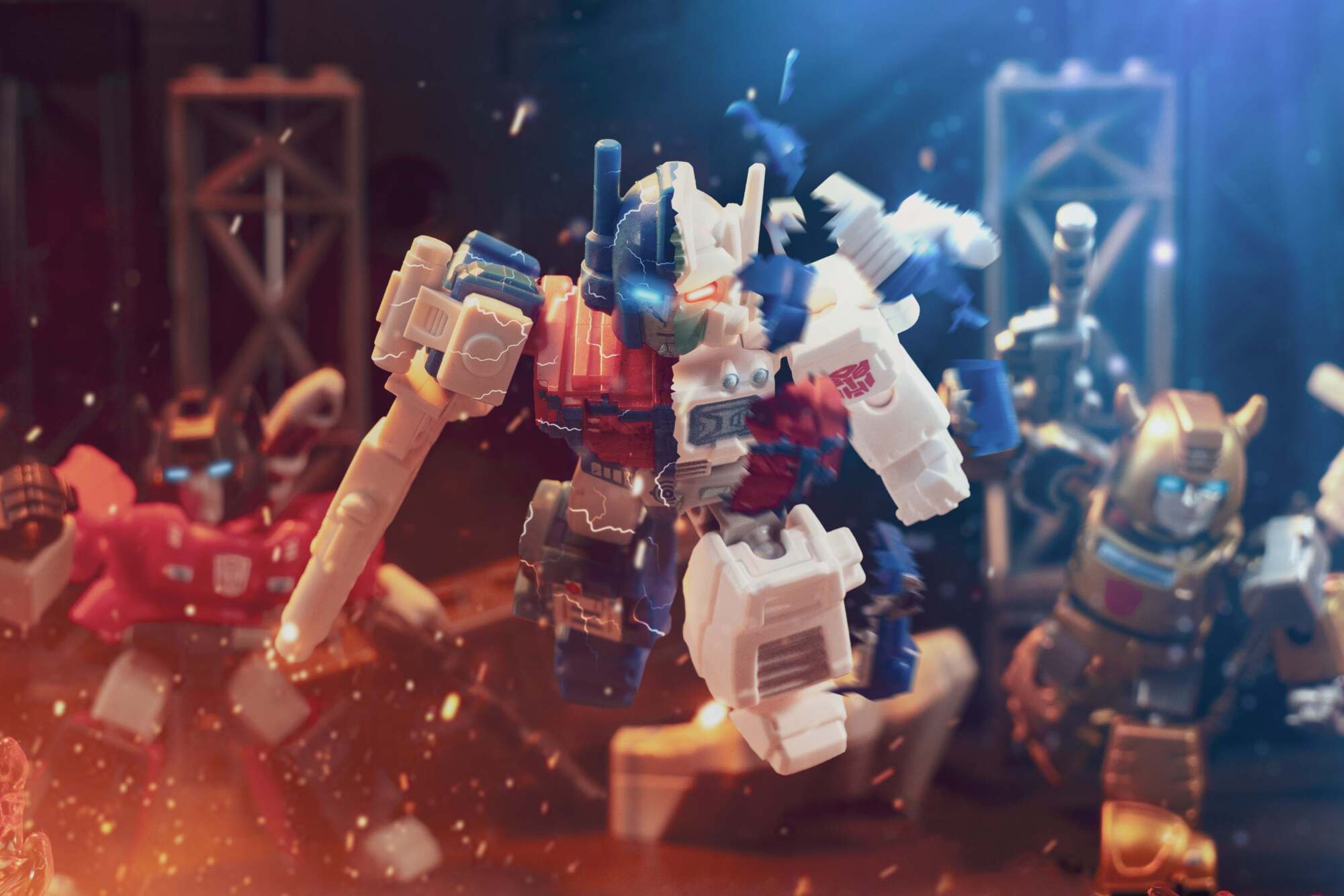
AI stands for artificial intelligence. It’s the term that’s thrown around an exhausting amount these days. It feels like a big marketing gimmick. Every company seems to be touting some grand AI feature that will make life better and easier.
Spoiler alert, AI is actually not the one-click lifesaver it’s chalked up to be. I’ve seen the detrimental effects of AI infecting many creative hobbies all across the internet. And now toy photography is starting to suffer the consequences of AI as well. The real question here is ‘why is AI bad at all?’
The real question I want to ask here is: ‘Why is AI bad?’ It’s just a tool, right?
Terminology Nitpick
I have a bone to pick with the term ‘Artificial Intelligence.’ There’s nothing intelligent or sentient about AI. There are no thoughts, emotions or soul behind the tool. The term gives a false impression that when generative AI is used, there’s a little robot mind considering the photo or prompt and building a carefully crafted result.
There is no will, independent thought or even intention behind the results… just numbers.
WHAT’S WRONG WITH USING AI?
When I speak out against using Ai in toy photos I often hear the response: ‘It’s just for fun, don’t take it so seriously’. When a photographer sits down, slap a toy on the desk and suddenly the figure appears in a perfectly lit scene…what could possibly be wrong about that?
Plenty.
To properly address my concerns, I want to take a step back and ask: why does anyone do toy photography in the first place? Everyone has nuanced answers, but when it’s all boiled down, there’s a common theme. Toy photography is an exercise in creativity that allows for freedom and playfulness in a world lacking play and creativity in many spaces. It’s a way to tell stories while visually bringing thoughts and ideas to life. Best of all, it has an incredibly low bar of entry.
AI easily fits into that, right?
I firmly believe it does not. Can a person be called a painter if they sit in a chair and shout commands to the person holding the brush? Photography is as much an art form as painting. It’s the study of light, color and composition. Photos that look good to a viewer, look good for a reason.
Popping a photo down the gullet of generative AI to get a backdrop, effects or even lighting strips away the artistic process. It circumvents the pondering and puzzling that comes with creativity. Problem solving disappears. There’s no wondering: “How can I get a hazy light beam to come through a tiny window?” or “How can I create a campfire scaled correctly for my figures to sit around?” or “How do I create a somber mood for my image using rain?”
There’s far less THINKING involved when a machine is doing the heavy lifting. The purpose of this (or any) art form begins to erode when the ideas and emotions of the artist are left up to the interpretation of AI.
DIGITAL EDITING VS AI
Comparisons between Photoshop (or any digital editing tool) and AI pop up often. As an avid Photoshop user, I take a bit of offense at that. I’ve come across the sentiment that AI is just Photoshop for people who have better things to do with their time. That’s a goofy argument to me.
Photoshop is a tool in a photographer’s toolbox – tools like a camera or lenses. Although not nearly as mandatory since plenty of photographers create amazing, edit-free shots with practical effects.
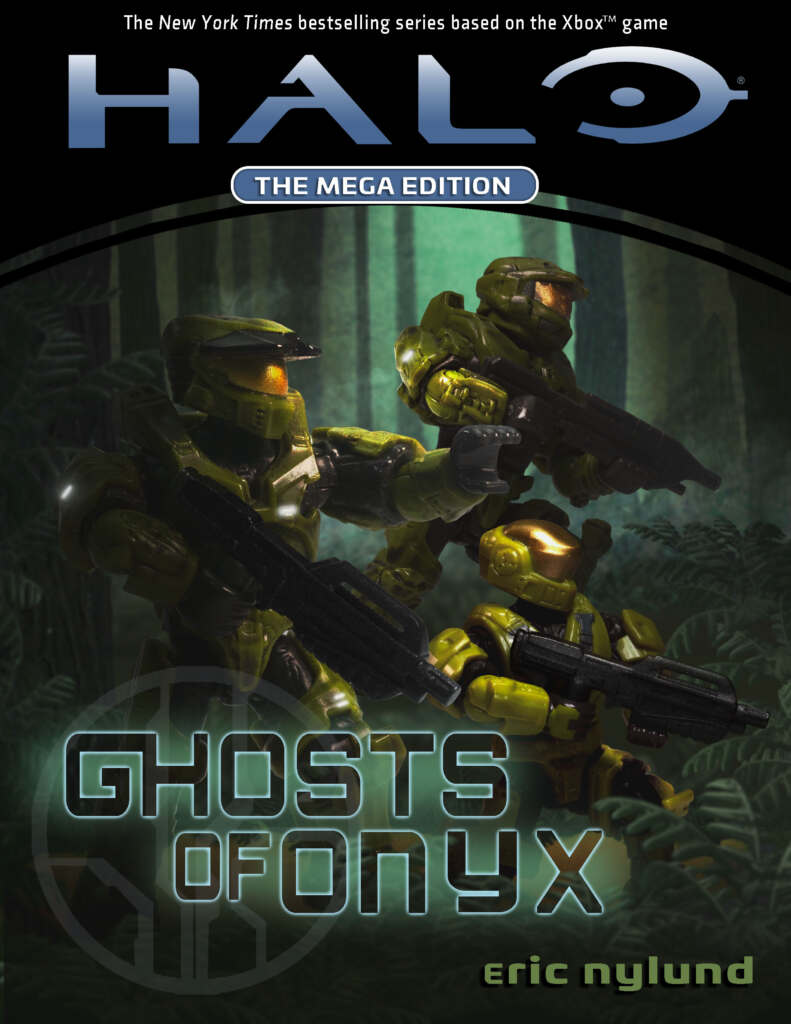
Personally, I love the options Photoshop provides. For example, I recreated a book cover using toys. After I shot the individual photos, I embarked on a three hour Photoshop session to flesh out my idea. It took blending, copying and stretching a few toy plant photos to make a deep forest backdrop. That was not possible practically with what I had. AI could have done it in a fraction of the time…and the purpose behind it would have been lost. Every bush and tree was placed with the intention that a machine simply cannot achieve.
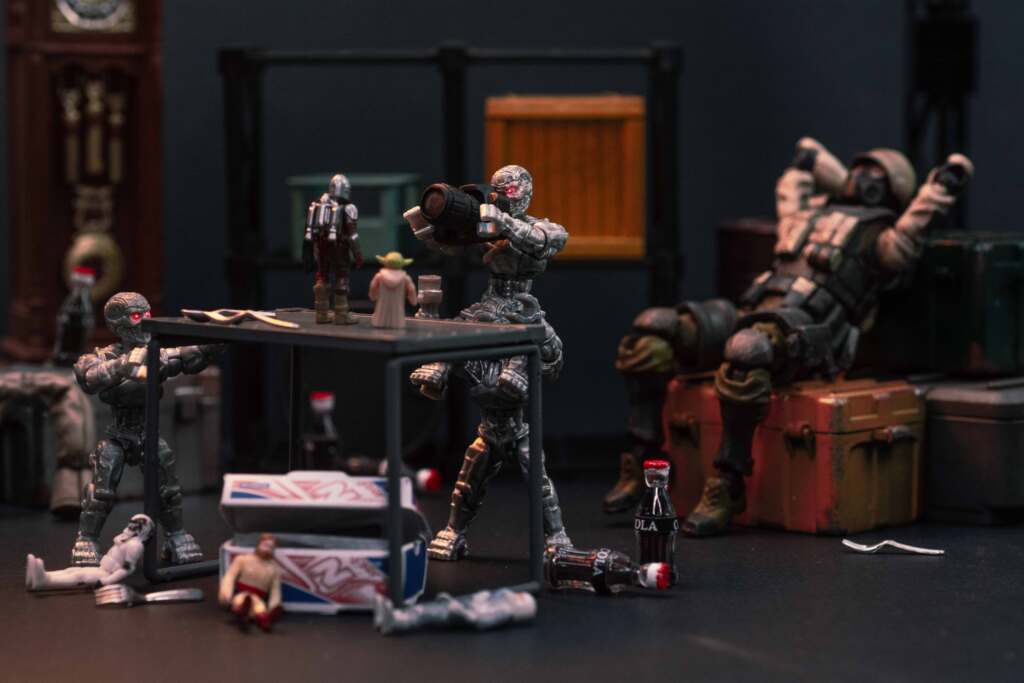
I was working on a shot recently and I was really struggling with the background. Ultimately the background didn’t matter. Its purpose was to set the stage for the focus of my image; the figure in the center of the mele.
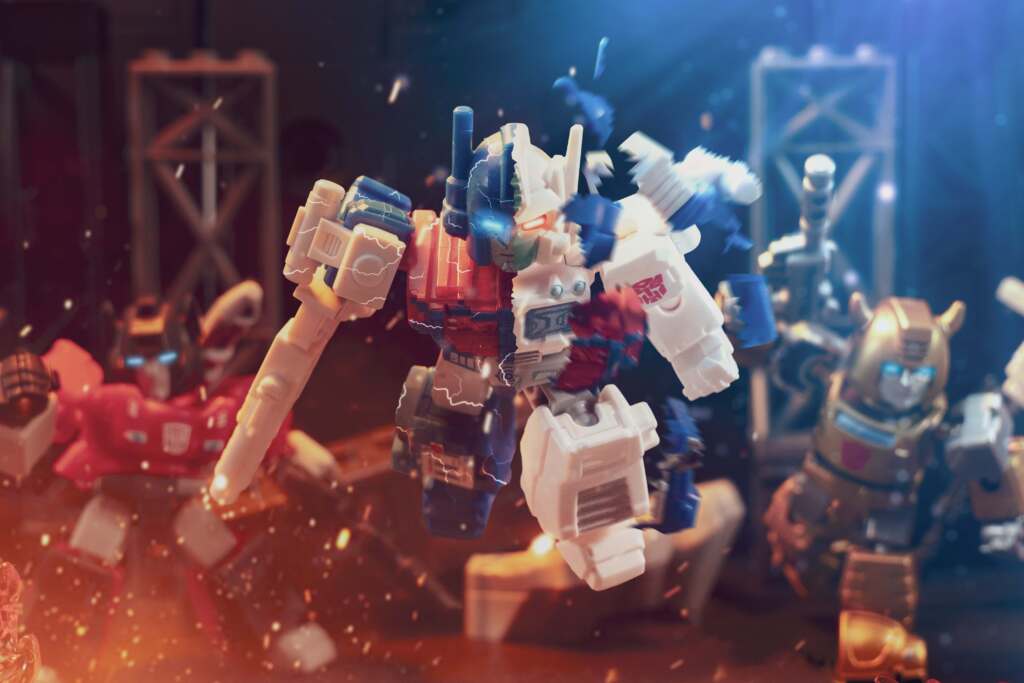
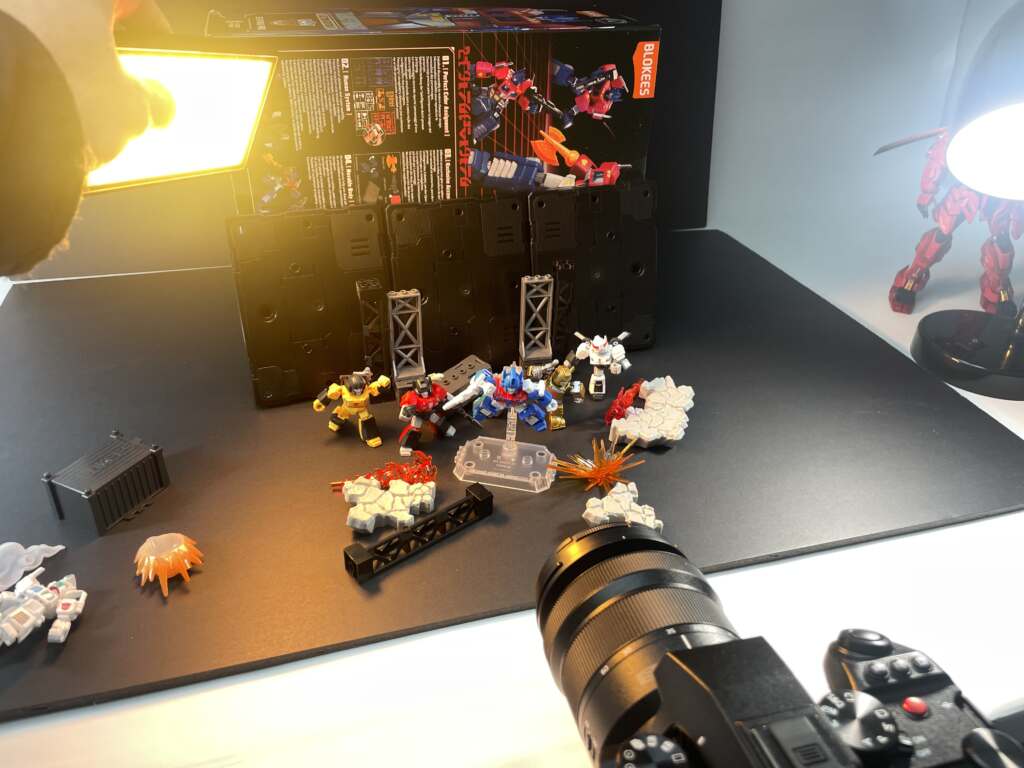
I thought for a good ten to fifteen minutes and ended up trying a few things before settling on the setup you see below. It would have been faster and easier for AI to generate the background for me. But I would have learned nothing if I had chosen that route. Next time a similar situation arises I can use the knowledge and ideas I gained through this process.
While writing this article, I had several chats with fellow Toy Photographer RedeemerStudioz. He told me about a shoot he did that required an environment he didn’t have. Two options presented themselves: go the Photoshop route, or rethink the shot entirely. He tried the digital edit and wasn’t pleased with it. That brought him back to the drawing board.
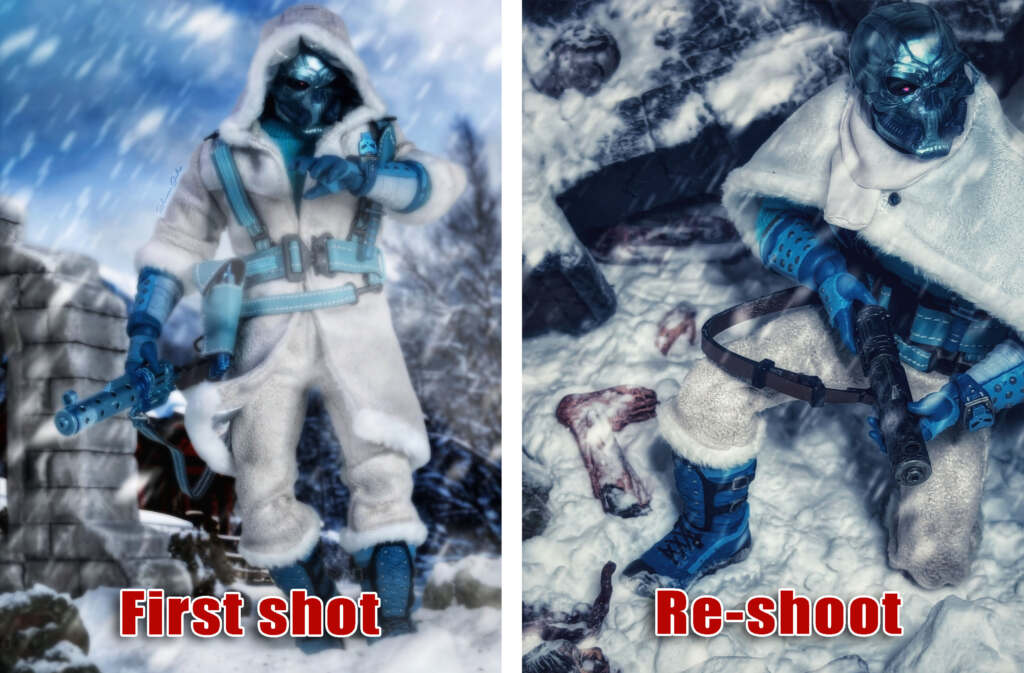
He re-posed, re-framed and re-shot. The end result was very different than the original idea, yet told a better and more engaging story. More importantly, he walked away with knowledge and experience he can use on his next photo.
The journey of success and failure is gone in a few clicks with AI. A photographer who relies on AI for any aspect of their photography process does not gain knowledge or experience. There is no enrichment to be found in computer-generating that which should be discovered.
There is speed and results to be found in AI. I won’t deny that AI can churn out some visually impressive shots. For anyone trying to ‘win’ at the hollow game of social media, nothing is going to beat rapid-fire posting eye catching ‘photos.’ When a lot of people choose this route, all the photos begin to…kinda just blur together. Everything looks the same. Lighting, depth of field, levels of distortion and grain, all being repeated endlessly. Remixed into an easily-swiped through pile to fill a doomscrolling session.
Authenticity vanishes. Nobody develops a unique style.
I’ve gotten into arguments (probably too many) with AI enthusiasts in the toy photo space and something I heard a lot is: you should be encouraging new photographers who use AI. After all, everyone has to start somewhere.
I call baloney on that.
I will admit It that being a beginning toy photographer can be daunting. So many amazing artists who create images with technical skills that seem impossible to attain. It might even seem like all the ideas are already taken.
Ultimately none of that is important. What matters is learning.
I’ve learned over the years by examining the work of photographers I admire, copying their style and sometimes even their ideas. The more I did that, the more I realized what aspects of their work I liked and it blended slowly into a style that was my own. It took a long time for me to develop the skills I have today and I’m STILL learning. Some of the skills I’ve gained on this journey have helped further my ‘real’ career.
Imagine if I had taken the shortcut of AI. My work would be much the same today as it was over eight years ago. There’s no shortcut for true learning. Nobody will ever start out perfect. Embrace the failures as much as the successes. THAT is what gives art its meaning.
What do you think about AI us in toy photography? Yes, no, or is the jury still out? Feel free to join the conversation below.

An excellent article and I agree whole heartedly. It’s an instant red flag to me and I’ve unfollowed so many accounts for using Generative AI. You’ve articulated the issues very well, thank you!
Thanks for reading! I’ve been unfollowing accounts too lately and I’m now instantly suspicious of certain shots, which makes me sad
THANK YOU! You put my feelings and thoughts into well written post. I totally agree with you. I hate AI generated pictures, they look wrong. And AI is actually “stealing” our thinking capacity. When you outsource all the thinking, your brain muscle will stop working. Like when you stop working out your body. Same thing. So maybe if we just wait a bit, then all these AI enthusiasts will dumb themselves enough and they won’t be able to function without it. This bullshit keeps being pushed down our throats at work too. So far I have seen maybe one use case when it actually made sense. The rest is just a bubble, trying to convince everyone that it’s helpful. I’m sure there are fields where it makes sense, to use it as a model for simulations, but the text generation models are just a fancy toy for rubbish.
The only time I am okay with ‘AI’ use is things like Topaz and Photoshop’s subject select. Topaz simply repairs existing images and Photoshop has had the select tool for far longer than the AI craze. They just added the AI label to make more people use it. People are ALREADY getting to the point where they can’t function without Chat GPT telling them what to do so the divide will be getting sharper and sharper from here on out
It is a very contentious subject, but AI has offered some alternate solutions which I have embraced in some of my toy photography. Note – some – as I still enjoy getting outside when I can, but this isn’t always possible and I don’t have the space or equipment for a full photographic studio setup with purpose built backgrounds. If it’s looked at as if it is a tool, then perhaps it’s comparable to Photoshop – a tool that gets more useful as you learn more about it.
Currently, AI is creating strong polarised opinions; interestingly it reminds me of Duchamp’s 1917 submission of a urinal in an exhibition which forced debate on whether art requires technical skill or if the act of choice is enough.
Interesting blog post and I look forward to reading considered opinions on this!
Definitely a polarizing topic. I have to disagree with your point about using it as a tool–as I showed off in the article, I didn’t have full purpose built backgrounds either and that was the challenge of that shot. Working through the puzzle of ‘how do I achieve this shot without the proper setup’ is a HUGE part of the learning process. Simply viewing AI as a tool doesn’t change the fact that generating a background robs you of that learning process and the potential failures of the first attempts.
Photoshop has features that Adobe claims is AI, such as the object select tool, that I do think are helpful. But that tool has been around for way longer than the AI craze, it just had the label added recently. I know the transition to digital photography and then the introduction of Photoshop spawned similar debates in the past, but never before has there been the option to remove the human influence on our art.
I have to agree with this. I love creating my own scenes and sometimes AI would be easier but in truth, there is absolutely no fun or creative thought in that.
It takes the play out of imagination and creation.
It really does, and I think we’re already losing a lot of imagination in this age of ‘everything has to be tied to a big name show, movie or game.’
What a nice article, with some nuanced thoughts, but still with a strong message, with which I agree. Having spent much of my adult professional life as an AI researcher(*), I am increasingly worried that for many tasks, skills (and hobbies), people will take the “frictionless” shortcut of employing AI to generate any answer for them. But, people tend to forget that without the process of actually doing all the in-between-steps yourself, you will lose the ability to even understand or evaluate properly the end product. Writing a text typically trains your capability to acquire and capture knowledge, to organize your thoughts, to lay out a plan to argue to your desired conclusion, and to properly use all the language tools you have in your mind to convey it in an interesting or aesthetic form. Without practicing all these steps, you will not really be able to come up with a proper text yourself, and in the long run, even lose your ability to really understand -a- text deeply. The same goes for toy photography, as nicely outlined in the article.
My core reason for reacting to this article is that I just happen to have crafted a (kind of) new year’s resolution card, based on Lego-toy photography, making a fairly similar/related point as this article:
https://martijnvanotterlo.nl/BLOG15012026-Nieuwjaarskaart.html
So, I started, essentially, with the conclusion of the article (do it yourself, don’t delegate to AI), and used toy photography to visualize it. On the page I also added the “behind-the-scenes” shots (maybe, now I think about it, to prove chatGPT really did not generate the images 🙂 ).
(*) Just some tiny “personal view” additions: 1) I typically see AI in terms of this (out of many) definition: “The goal of work in artificial intelligence is to build machines that perform tasks normally requiring human intelligence.” (Nilsson, Nils J. (1971) This may make it easier to see AI still as “intelligent” in some way (but not sentient), 2) It is true that AI does not really “understand” things in the way we (think we) do. This is (one reason) why chatbots still make so many mistakes, even though they can perform amazingly on many language-oriented tasks already. 3) The “generative” part is what makes AI currently so cool and powerful, based on recent advances in neural networks. However, decades ago, generative models existed already, in the form of grammars (and related models) and they were used to generate (3D) structures… Yes… one could use them to come up with Lego models, and some recent research is doing that (combining older and newer techniques). However, also here, we get the the exact same dilemma: frictionless generation of (parts and) instructions for Lego set X based on a single prompt vs. doing it all yourself and enjoying the process, and learning along the way…
I love the shots on your blog! Fantastic setbuilding
Also that’s a pretty good definition of AI I think, and it highlights the major issue with applying a machine built for tasks requiring human intelligence to any sort of hobby, entertainment or art form.
I find great joy in planning and creating sets and environments for my toy photos. Much of that joy would be lost without that part of it. I can’t imagine using AI to remove that joy.
Agreed! That’s half the fun!
I must admit I have played around with AI out of curiosity but I don’t like AI generated images. It’s o.k. for people who aren’t photographers, either by lack of interest or lack of equipment, but there are always the dishonest ones who use ai then try to claim it as a genuine photo. That is so wrong. There are so many ai generated videos of people and animals doing wonderous things on Youtube that I have become very cynical about stuff I see out there now. I’m first and foremost a photographer and I enjoy the challenges of trying to achieve as much as I can in-camera. I do use photoshop to edit, but my photoshop version is from 2012, so no modern day “ai” add ons there. I do use layers and focus stacking a lot, and I also use Topaz, (the original version) and Nik software. All outdated but still perfectly usable. I use ai for two things. One is to generate personalised birthday cards for friends and the other is to animate my own original images into 5-10 second reels. It’s actually quite fun to see your own images come to life. Ai is very unpredictable and so it can be very time consuming and you do actually have to learn how to direct the ai agent on what result you want. Sometimes the results can be quite hilarious. Having said all that, I read a daily “magazine” called the Rundown which tells you the latest in the ai world and, to be quite honest, it is quite scary just what people can do with ai. I don’t understand a lot of the jargon, but I do know that it has the potential for a lot of harm if misused. Unfortunately, ai is here to stay, the Genie is out of the bottle, and I believe , instead of dismissing it and trying to ignore it, we need to educate ouselves on just what it can do, or what people can do with it, just to protect ourselves.
The funny thing about some of Photoshop’s ‘AI’ features is, they’re the exact same as they were, just more advanced. Image selection is the big one. Topaz is also a great tool use of AI. There have been a few video projects that I worked on for my day job that would have been unusable without Topaz’s uprez capabilities.
I honestly think that generating images is bad period, for photographers or not. Same with the animation apps. Entertainment shouldn’t be the use of AI. Use these more advanced algorithms for constructive things, not replacing humans. There are plenty of dangerous and difficult tasks that could be made smoother with such things but we’re out here burning tons and tons of energy on crapposts for reddit.
You are right though, it’s not gonna just go away, sadly.
For me AI is a part of my process , creativity and my voice. There are so many options out there to explore and to take my photography toy art further. I am not using AI all the time, but there are a lot of learning with so many possibilities with AI models. The map is not complete.
thanks for writing this. a lot of wisdom here and in the comments. to add to all of this i would like to mention the hyperaccelerated carbon footprint that ai data centres create. as they say, if it’s cheap someone else is carrying the cost. the ease of ai is a total ruse.
This is a good point. I didn’t touch on it because I don’t have enough knowledge to properly cite any real data but you are 100% right that this ‘cheap’ or even ‘free’ tool is pulling an INSANE amount of resources.
Thanks for the article, Zee. You’ve hit on a lot of good points so I won’t just repeat them in yet another comment. I do appreciate your defense of Photoshop which has taken a lot of abuse lately for adding “AI” next to tools they have had for years. I love working with PS and some other apps to see what I can add to my photos. I played with AI when it first appeared on the scene and quickly abandoned it. I want to “play” with my tools and a photo, creating my own world. I also love taking toys outdoors when I can to see what inspires me out there.